
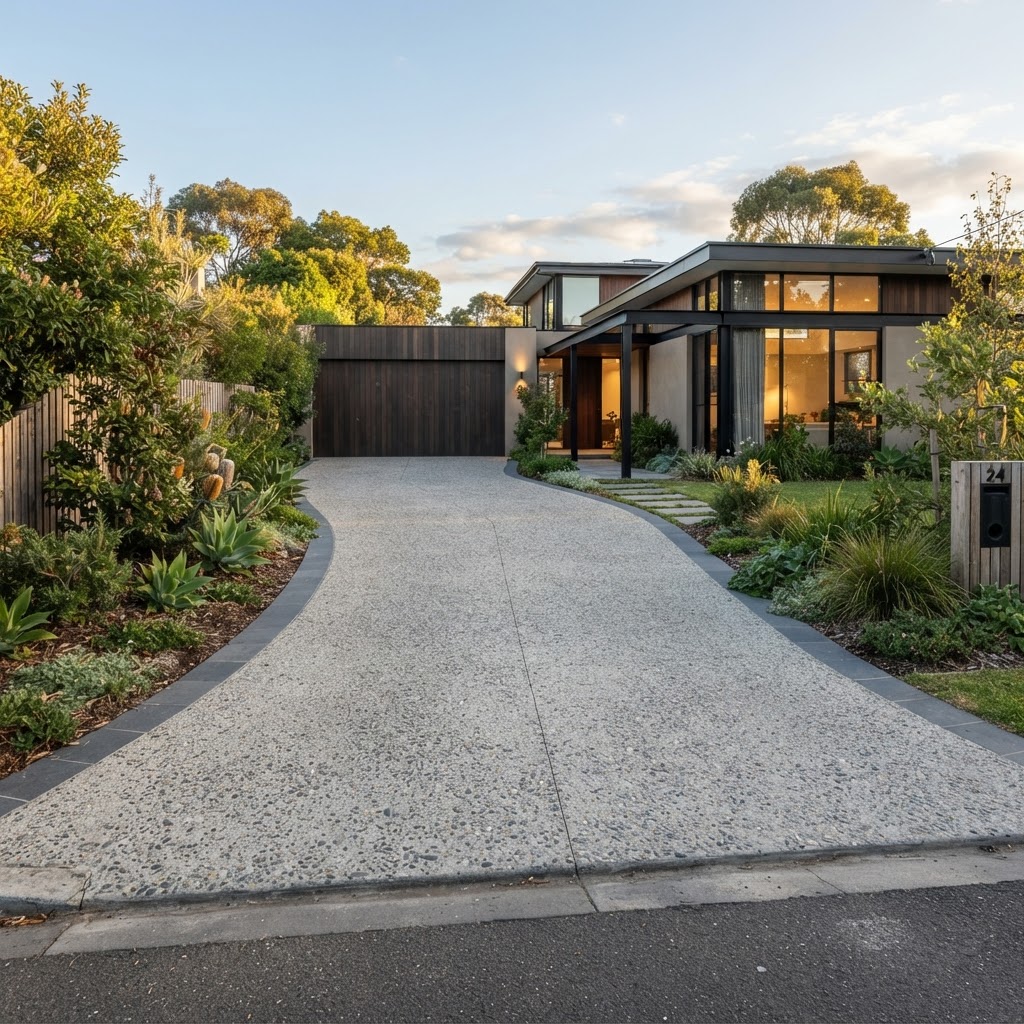
What exposed aggregate actually is
Exposed aggregate is concrete made with a decorative stone blend, poured and finished like normal concrete, then treated so the top film of cement paste can be washed or lightly ground away. What is left is a surface of partly exposed stones held firmly in the concrete. The finish depends on three decisions:
Rounded river pebble, crushed quartz, granite, basalt and mixes of them, in several sizes and tones. Many suppliers sell named blends, and searchers often know names such as "Balcombe" or a "grey base" mix. Those are examples of supplier ranges, not recommendations; availability changes, so samples are compared at the site look.
The cement around the stones can be natural grey, off-white or tinted with oxide. A charcoal base makes light stones pop; a natural base gives a softer, more even look.
A light exposure shows just the tops of the stones for a smoother feel underfoot. A deeper exposure is more textured and dramatic.
Why it suits Bayside homes
It forgives daily life. Tyre marks, leaf stains from street trees and the odd oil drip are much less obvious on a speckled stone surface than on plain grey concrete.
It grips. The texture gives good traction in wet weather, which matters on sloping driveways and around pools. Grip can be fine-tuned with stone size and a grit additive mixed through the sealer.
It ages gracefully. Because the visible surface is stone rather than coloured paste, exposed aggregate holds its look better under strong sun than many coloured finishes, provided the sealer is maintained.
It suits both old and new. Soft, warm blends sit comfortably in front of Victorian and inter-war houses; crisp charcoal and white blends complement contemporary rebuilds.
Choosing stone and colour for your house
There is no single "best" exposed aggregate colour, but there are patterns that work well in Bayside:
- Red brick and terracotta roofs pair with warm blends that include browns, rust tones and cream.
- Sandstone or rendered period homes suit creamy quartz blends on a natural or light base.
- Modern homes with black window frames and white render look sharp with charcoal, grey and white blends, often on a tinted base.
- Homes with lots of timber and garden suit natural river pebble mixes that feel softer and less engineered.
Look at your roof, window frames, front fence and any existing paving, and bring photos of driveways you like. The concreter will bring physical samples so you can see them in your own light. Remember that wet stone looks darker and richer than dry, and a gloss sealer will deepen colours more than a matte one.
Where exposed aggregate works best
Driveways
The most common use. Exposed aggregate driveways are popular in Hampton, Brighton East and Beaumaris, where wider frontages show the finish off. See concrete driveways for base, steel and drainage details.
Paths and side access
Front paths in exposed aggregate tie the entry to the driveway. Side paths in the same finish give a consistent look around the house. See concrete paths.
Patios and alfresco areas
For entertaining areas, a finer stone and lighter exposure are kinder underfoot and easier to set furniture on. See concrete patios.
Pool surrounds
Plenty of Bayside pools are edged in exposed aggregate for its grip. Lighter stones stay cooler in summer. See pool surrounds.
The honest downsides
Exposed aggregate is not perfect, and you should know the trade-offs before choosing it:
- It needs sealing. Unsealed exposed aggregate can lose stones at the surface, stain more easily and dull over time. Near the bay, re-sealing is part of owning it.
- It can be harder to clean. The texture holds dirt more than a smooth surface. A pressure wash on a sensible setting usually brings it back.
- Repairs show. Patching a section rarely matches perfectly because the stone, base colour and weathering will differ.
- Texture underfoot. Deep exposure can feel rough for bare feet or high heels. A lighter exposure or smaller stone solves this for patios and pool areas.
- It is more involved than plain concrete. Extra steps, timing on the day and decorative stone mean it generally costs more than a plain finish.
Can exposed aggregate go over existing concrete?
This is one of the most common questions. A full exposed aggregate pour usually cannot be placed in a thin layer over old concrete, because the stone needs enough depth to bond and the slab needs to be thick enough to resist cracking. There are thin decorative overlays that mimic an aggregate look, but they are a different product and suit sound concrete only. If the old slab has cracked, dropped or heaved, replacement is usually the better long-term choice. Our repairs and resurfacing page covers when an overlay makes sense.
How an exposed aggregate pour happens
Preparation
Excavation, a compacted crushed-rock base, formwork and steel reinforcement, the same as a quality plain driveway.
The pour
The decorative mix is placed, screeded and floated to level.
Surface retarder
A product is often sprayed on to slow the setting of the very top layer, so the paste can be washed off while the body of the slab hardens.
Washing off
Timing is everything. Wash too early and stones come loose; too late and the paste will not move. The surface is washed and brushed to the agreed exposure.
Joints
Control joints are saw-cut once the concrete can be cut cleanly.
Acid wash and seal
After curing, the surface may be cleaned to remove cement haze, then sealed.
Sealing exposed aggregate near the coast
Salt spray, sun and rain all work on concrete near Port Phillip Bay. A good sealer slows water and salt getting into the surface, makes cleaning easier and lifts the colour of the stone. Options range from penetrating sealers that stay invisible to film-forming acrylic or polyurethane sealers that give a satin or gloss look. Film-forming sealers wear and need recoating; penetrating sealers last differently and change the look less. The right choice depends on the use and the look you want. Our concrete sealing page and coastal concrete care guide go into more depth.
Day-to-day care
Living with exposed aggregate is easy if you build a few habits. Sweep or blow off leaves regularly, especially under gum trees and Moreton Bay figs, because tannins left sitting on the surface can stain. Hose off salt residue after windy spells if you live within a few streets of the beach. Clean oil drips promptly with a degreaser suited to sealed concrete rather than a harsh solvent that could soften the sealer. When water stops beading on the surface after rain, the sealer is wearing thin and it is time to talk about a re-seal. Avoid metal-bladed shovels and stiff scrapers on the surface, and lift rather than drag heavy pot plants so they do not scuff the stones. These small steps keep the stone looking crisp for years between bigger maintenance jobs.
What affects an exposed aggregate quote
- area, shape and access for the truck or pump
- removal of old concrete or other surfaces
- excavation and base depth
- the stone blend and base colour chosen
- depth of exposure and any pattern or border work
- reinforcement for the loads expected
- drainage and crossover works
- sealing and any anti-slip additive
Prices are never published on this site. A free site look gives you a written quote for your actual job.
Exposed aggregate across Bayside
Exposed aggregate driveways are the headline job in Hampton, where a high share of separate houses and renovated frontages drive demand. We also arrange it in Brighton East, Black Rock and Elsternwick. If you are weighing up options, read exposed aggregate vs pavers vs plain concrete.
Exposed aggregate FAQs
It needs sealing and occasional re-sealing, it can hold dirt in its texture, patches rarely match perfectly, and deeper exposure can feel rough underfoot. For most driveways and paths, the durability and grip outweigh these.
Blends with charcoal, grey and white stones are common on contemporary homes, while warmer brown and cream blends are popular on period houses. The right choice depends on your roof, walls and garden.
It is generally one of the grippier concrete finishes. Grip depends on the stone size, exposure depth and sealer, and the sealer can carry an anti-slip grit for pool areas and steep driveways.
A close match is sometimes possible if the original blend is still available, but weathering and base colour make an exact match unlikely. A contrasting border or redoing the whole area are common solutions.
Well-built exposed aggregate on a good base can last for decades. The surface look depends on sealing and cleaning; the structure depends on the base, steel and joints.
Not as a full pour in a thin layer. Decorative overlays can imitate the look on sound concrete, but cracked or sunken slabs are usually better replaced.
Get an exposed aggregate quote
Send us photos of your home's frontage and any driveways you admire. We will bring samples to a free site look and follow up with a written quote.