
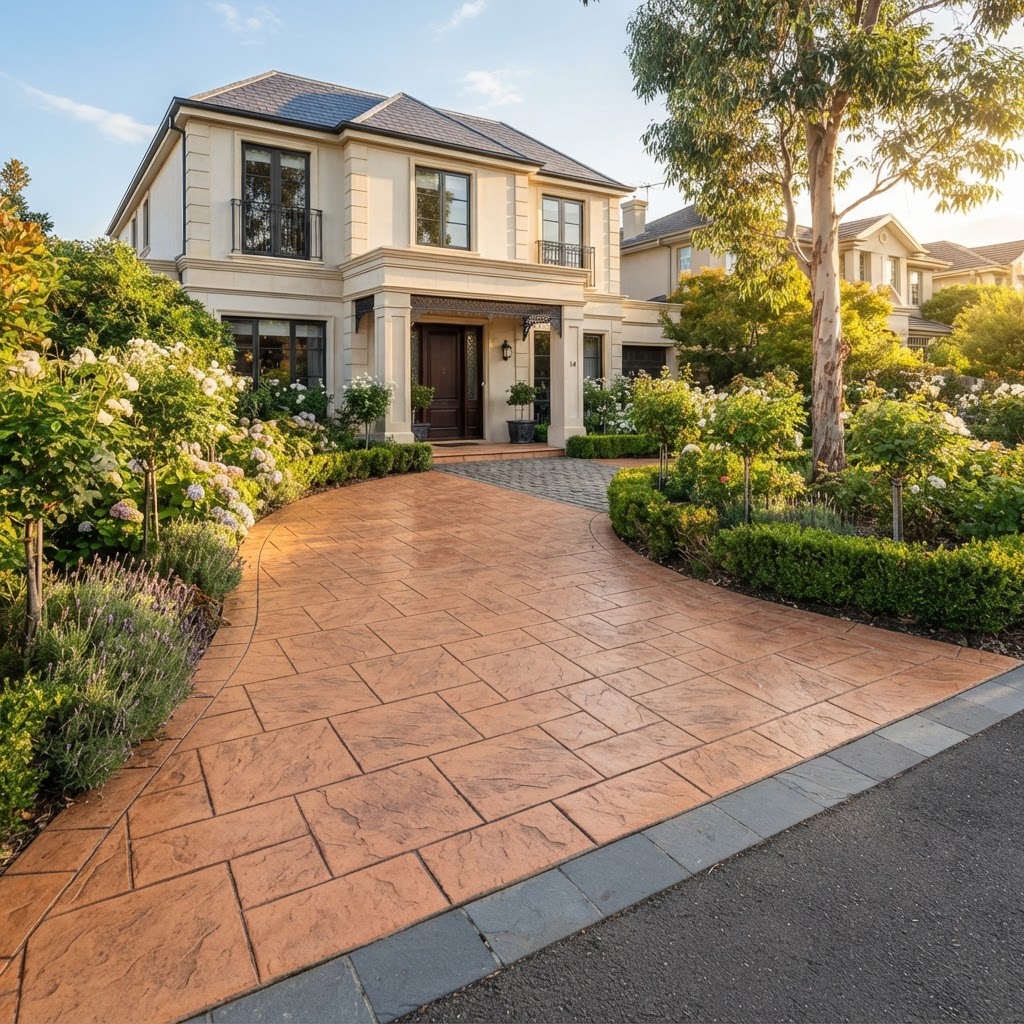
Decorative options at a glance
Coloured concrete
Colour is added as oxide pigment mixed through the concrete, so the colour runs through the whole slab rather than sitting on top like paint. Popular tones include charcoal, slate grey, sandstone, terracotta and warm browns. Coloured concrete suits paths, courtyards and driveways where you want a clean, continuous surface with more warmth than plain grey.
Colour-hardened surfaces
Some finishes use a coloured dry-shake hardener worked into the surface of fresh concrete. It gives a denser, more intense colour at the surface and is often used as part of stamped finishes.
Stencil concrete
Paper stencils in a pattern, such as brick, cobblestone, tile or ashlar stone, are laid on fresh concrete and a coloured surface layer is applied over them. When the stencil is removed, the pattern shows as grout lines. Stencil finishes give a paved look in a single pour without individual pavers that can lift.
Stamped (pattern-imprinted) concrete
Rubber texture mats are pressed into still-soft concrete to mimic stone, slate, timber boards or cobbles. Release agents in a contrasting colour settle in the low points to add depth. Stamped concrete offers strong texture and realism but needs skilled timing on the day.
Banding, borders and saw-cut patterns
A simpler approach: a border of exposed aggregate or contrasting colour around a plain centre, bands across a driveway at regular intervals, or saw-cut grids that mimic large-format pavers. These details add interest without dominating the house.
Matching decorative concrete to Bayside homes
Bayside has a rich mix of architecture, and the best decorative choice depends on the house:
- Victorian and Edwardian homes (common in Brighton, Elsternwick and parts of Caulfield South) suit restrained finishes: charcoal or slate-coloured concrete, simple borders, or a stencil that echoes bluestone. Busy patterns can feel out of place.
- Inter-war bungalows and Californian-style homes often look right with warm terracotta, brown or sandstone tones that pick up the brickwork and roof.
- Post-war and mid-century homes (found across Bayside) suit clean, unfussy surfaces: plain or lightly coloured concrete with neat joints.
- Contemporary rebuilds pair with charcoal, deep grey or crisp saw-cut grids that mirror the lines of the architecture.
Where a property is within a heritage overlay, changes visible from the street can be subject to planning controls. Muted, natural-looking finishes are usually the safest choice, and checking your planning property report before deciding is wise.
Matching new colour to existing concrete
One of the most common questions is whether new coloured concrete can match an existing path or driveway. The honest answer is: rarely exactly. Existing coloured concrete has weathered, faded in the sun and been sealed, worn and stained over the years. New concrete in the same pigment will look darker and fresher. Options include:
- choosing a deliberately different but complementary colour
- adding a border or band so the join looks intentional
- replacing the adjoining sections at the same time
- recolouring the whole area with a coloured sealer, accepting that this is a surface treatment that will need maintenance
Fading on north-facing coastal sites
Brighton's sunniest frontages face north and west, and UV light gradually fades pigmented surfaces and some sealers. Salt air and sea breezes add wear. To keep decorative concrete looking good longer:
- choose mid-tones rather than very dark or very bright colours where sun exposure is high
- use a UV-stable sealer suited to coloured concrete
- re-seal on a regular basis, before the surface looks dull and starts absorbing water
- clean with mild detergents rather than harsh acids
Our concrete sealing page and coastal concrete care guide explain more.
Where decorative concrete works well
- Driveways: coloured or stencilled driveways with a contrasting border. See concrete driveways.
- Front paths: a stencilled or coloured path leading to a verandah. See paths and footpaths.
- Patios and courtyards: stamped stone or slate textures for entertaining areas. See concrete patios.
- Pool areas: only with careful attention to slip resistance and heat. See pool surrounds.
Decorative concrete vs exposed aggregate
Exposed aggregate is technically a decorative finish too, and it is the most popular choice in Bayside. It tends to hide dirt better and wears more gracefully because the visible surface is stone. Coloured and patterned finishes offer looks that aggregate cannot, such as a smooth charcoal path or a cobblestone pattern. If you are undecided, see exposed aggregate and our comparison guide on exposed aggregate, pavers and plain concrete.
Looking after decorative surfaces
Decorative finishes reward a little care. Sweep regularly so grit does not grind into the sealer under foot traffic and tyres. Wash with a soft broom, water and a mild, pH-neutral cleaner rather than strong acids, which can etch coloured surfaces and strip sealers. Avoid parking a hot car on freshly sealed concrete for the first few days, as hot tyres can mark some sealers. Lift rather than drag pots and furniture. Pressure washers are fine on a moderate setting held at a sensible distance, but a narrow, high-powered jet can damage stencil and stamped surfaces. When the surface starts absorbing water instead of beading, plan a re-seal before the colour begins to wash out.
How a decorative pour runs
Design and samples
Choose colour, pattern and border at the site look with physical samples.
Preparation
Excavation, compacted base, formwork and steel, exactly as a plain slab would get.
Pour
Coloured concrete is placed and finished, or a base slab is poured and the decorative surface applied.
Pattern work
Stencils are laid or stamps pressed at the right stage of setting.
Joints
Control joints are planned to fall within the pattern where possible.
Clean and seal
Release agents are washed off and a sealer applied after curing.
What affects a decorative quote
- area, shape and access
- removal of existing surfaces
- colour, pattern complexity and borders
- base preparation and reinforcement
- sealer type and number of coats
- any matching work on adjoining areas
Prices are not shown on this site. A free site look gives you a written quote.
Decorative concrete around Bayside
Coloured and banded finishes are popular on period homes in Elsternwick and Caulfield South, and on courtyard patios in Elwood. Contemporary charcoal finishes are common on rebuilds in Hampton.
Decorative concrete FAQs
All pigmented surfaces fade slowly in strong sun. Mid-tones, UV-stable sealers and regular re-sealing slow the process.
Some stamped textures and glossy sealers can be slippery when wet. Anti-slip additives in the sealer and choosing a textured pattern help.
An exact match is unlikely because the old concrete has weathered. A complementary colour, a border or redoing adjoining areas usually gives a better result.
It looks similar but is a single concrete slab with a decorative surface. It has no individual pavers to lift or sink, although the surface layer needs sealing.
Charcoal, slate grey and soft sandstone tones usually sit well with Victorian and Edwardian homes. Bring photos of the house to the site look and compare samples in daylight.
That varies with sun exposure, foot and car traffic, and the sealer chosen. Re-seal when the surface stops beading water or starts looking dull.
Related Services
Get a decorative concrete quote
Tell us about the area and the look you want. We will bring samples to a free site look and send a written quote.